- Services
H3 offers an ever-evolving and encompassing range of services ↳
 Car Park RefurbishmentExtending the life of your parking structure
↳
Car Park RefurbishmentExtending the life of your parking structure
↳
 Structural Repairs & ProtectionConcrete repairs & corrosion management
↳
Structural Repairs & ProtectionConcrete repairs & corrosion management
↳
 Structural WaterproofingSpecialist Waterproofing for Concrete Structures
↳
Structural WaterproofingSpecialist Waterproofing for Concrete Structures
↳
 Resin Floors & CoatingHigh-Performance Resin Flooring
↳
Resin Floors & CoatingHigh-Performance Resin Flooring
↳
 EVHard-wearing line and bay marking
↳
EVHard-wearing line and bay marking
↳
 ConsultancyPrecise care & attention for your project
↳
ConsultancyPrecise care & attention for your project
↳
 Specialist SurveysCondition Surveys, Defect Mapping & Investigation
↳
Specialist SurveysCondition Surveys, Defect Mapping & Investigation
↳
 Aftercare/Asset ManagementPlanned Inspection, Maintenance & Repair Support
↳
Aftercare/Asset ManagementPlanned Inspection, Maintenance & Repair Support
↳
 Movement/Expansion JointsAccommodating movement.
↳
Movement/Expansion JointsAccommodating movement.
↳
 Flooring SolutionsCarpet, Vinyl, LVT & Safety Flooring
↳
Flooring SolutionsCarpet, Vinyl, LVT & Safety Flooring
↳
 SwiftPatchOur Rapid Repair Service
- SwiftPatch
- Case Studies
Q- Park The Light - LeedsConcrete repair & coating works St Davids Dewi Sant - CardiffRemedial works Yoga Hero - LeedsInstallation of Polyflor The Flower Bowl Entertainment Centre - PrestonResin flooring Booths Supermarket - KendalReplacement and waterproofing of drainage channel Trinity MSCP, LeedsInstallation of Premium Parking Bays Booths, Ulverston - UcreteInstallation of Ucrete, UD200 UK Centre for Ecology & Hydrology (UKCEH), Lancaster - UcreteInstallation of Ucrete, UD200 Browse Case Studies
- Suppliers
- Updates
- Company
-
Services ↳
Car Park RefurbishmentExtending the life of your parking structure
↳
Structural Repairs & ProtectionConcrete repairs & corrosion management
↳
Structural WaterproofingSpecialist Waterproofing for Concrete Structures
↳
Resin Floors & CoatingHigh-Performance Resin Flooring
↳
EVHard-wearing line and bay marking
↳
ConsultancyPrecise care & attention for your project
↳
Specialist SurveysCondition Surveys, Defect Mapping & Investigation
↳
Aftercare/Asset ManagementPlanned Inspection, Maintenance & Repair Support
↳
Movement/Expansion JointsAccommodating movement.
↳
Flooring SolutionsCarpet, Vinyl, LVT & Safety Flooring
↳
SwiftPatchOur Rapid Repair Service
Case Studies
Suppliers
Updates
About The Company
Contact
case-studiesTrinity MSCP, Leeds
Installation of Premium Parking Bays
Premium Parking Bays Installation – Trinity MSCP, Leeds
Trinity Multi-Storey Car Park in Leeds never stood still. Vehicles moved in and out throughout the works, and the structure had to remain fully operational while improvements were made. That’s where H³ Construct came in — not to apply quick surface fixes, but to rebuild and redefine the space so it performs better and lasts longer.
13No.
Concrete Repairs
305m2
of Coating Installed
147Letters
Applied
Before any new system could be applied, the deck had to be stabilised. Thirteen distinct areas showed signs of breakdown — cracked concrete, spalling and historic patch repairs that had reached the reinforcement below the surface. These weren’t surface defects. They were indicators of localised structural failure.
Each area was cut back to sound concrete, removing all weakened material. Exposed reinforcement was cleaned, treated and protected to prevent corrosion continuing beneath the repair. The concrete was then reinstated using high-performance repair mortars selected to restore strength, durability and compatibility with the surrounding structure.
Only once the deck had been returned to a stable, continuous condition were coating works allowed to proceed. The aim wasn’t to cover defects, but to remove them and rebuild the structure properly before moving on.
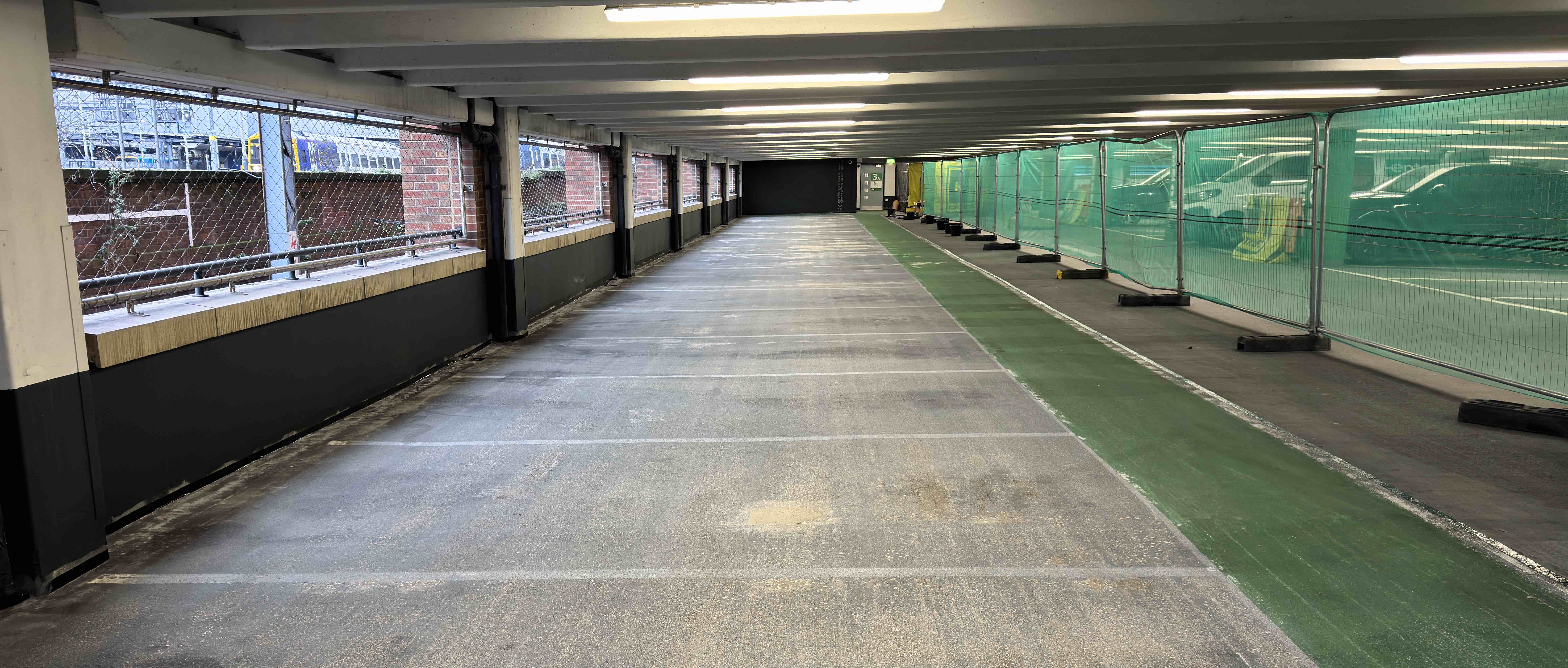
Substrate Preparation
Once repairs were complete, the deck was mechanically prepared using captive shot blasting. The process removed surface contaminants, laitance and any remaining residues left behind by previous finishes or repairs. What remained was sound concrete, exposed and consistent across the deck.
Shot blasting did more than clean the surface. It created a controlled profile designed to accept the coating system properly. This mechanical key is what allows primers and membranes to bond reliably under traffic, weather and thermal movement.
Preparation is the stage that determines how everything else performs. By taking the surface back to a clean, stable condition, the coating system could be installed with confidence — not relying on adhesion in theory, but on adhesion proven by the substrate beneath it.
Application of Primer
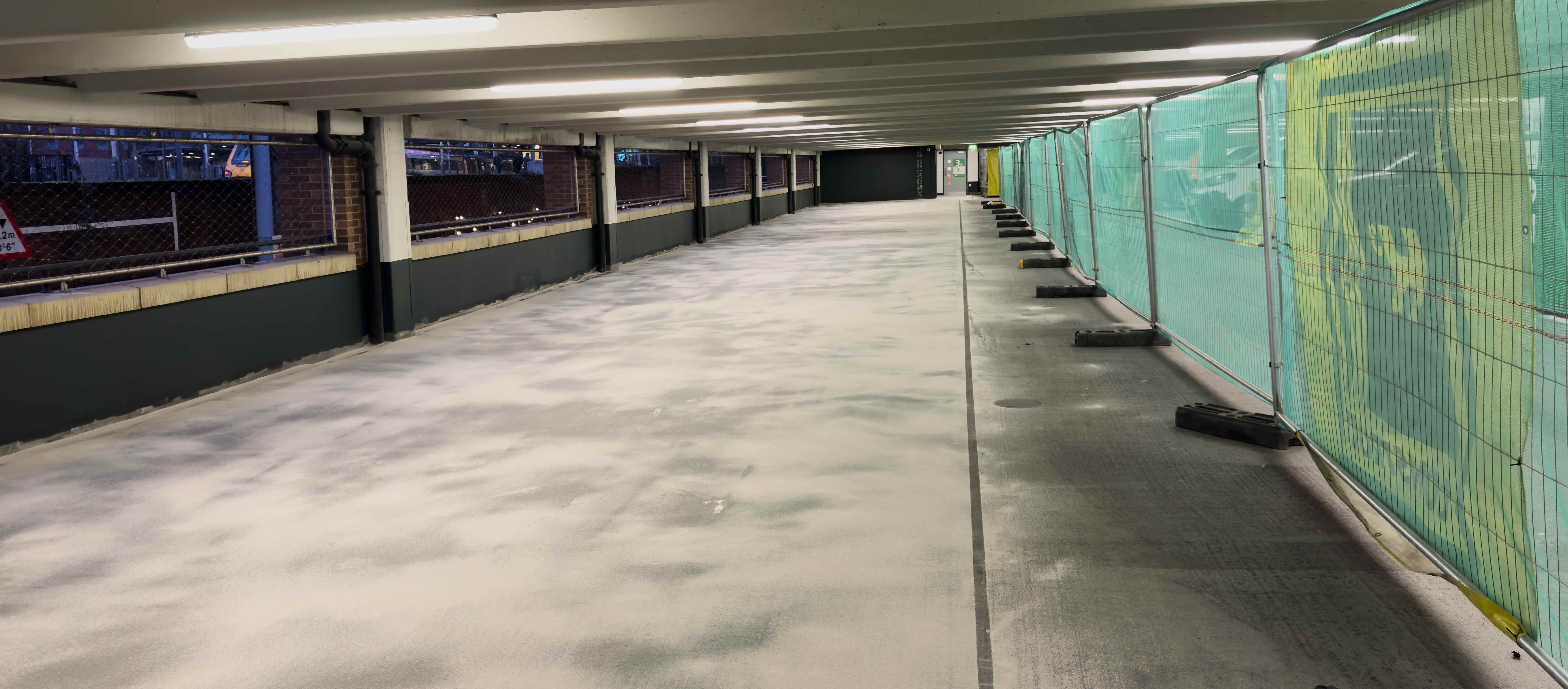
With the substrate fully prepared, a primer coat of Sikafloor-151 was applied to seal the surface and regulate adhesion across the deck. This layer formed the foundation for the system that followed, tying the coating into the concrete rather than sitting on top of it.
While the primer remained wet, graded quartz aggregate was broadcast evenly into the surface. This created a controlled, mechanically keyed profile designed to accept subsequent layers and resist shear forces under traffic and thermal movement.
The purpose of this stage wasn’t coverage. It was control. By sealing the substrate and locking in a consistent bond profile, the coating system could be built up with confidence, ensuring reliable performance over time rather than relying on adhesion alone.
Application of Seal Coat
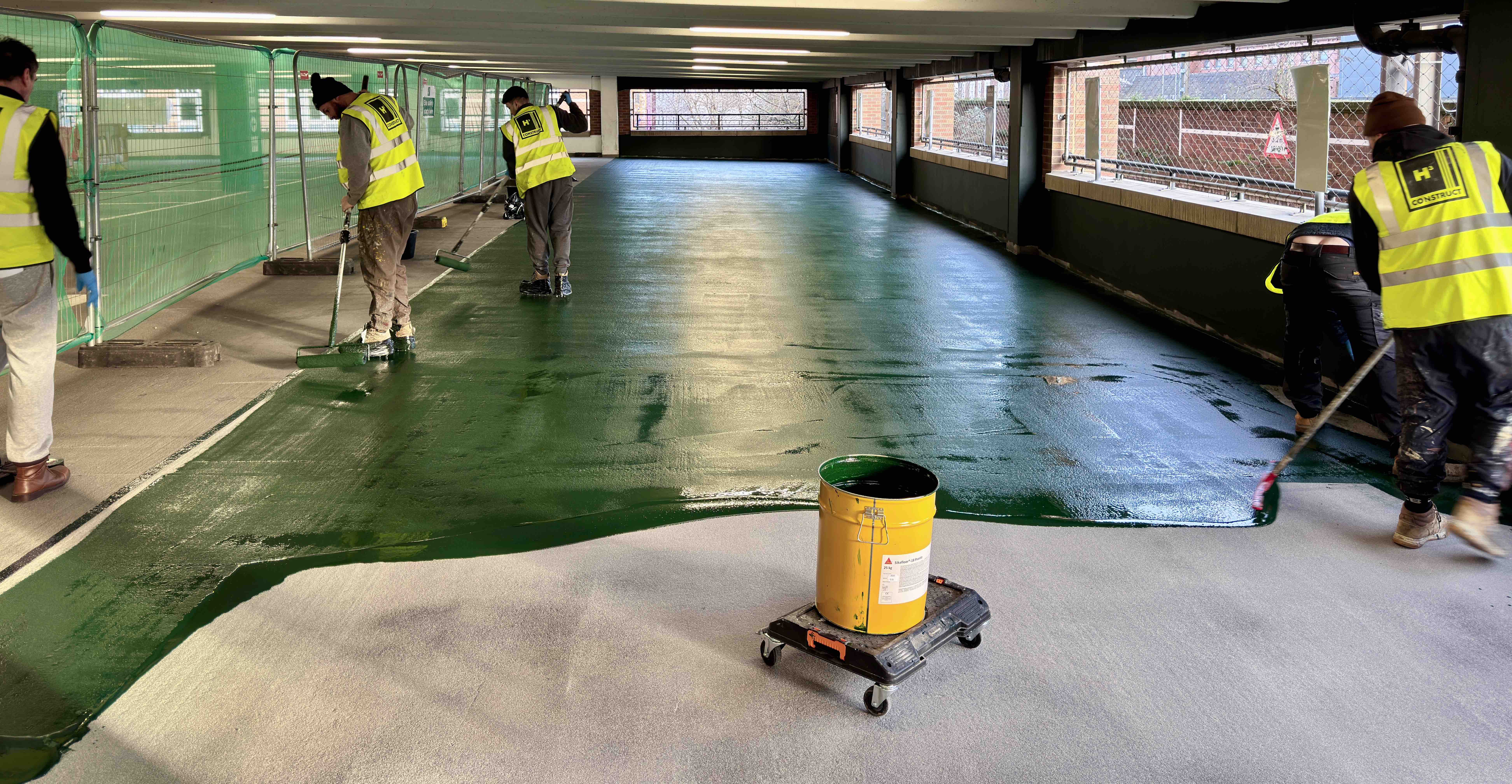
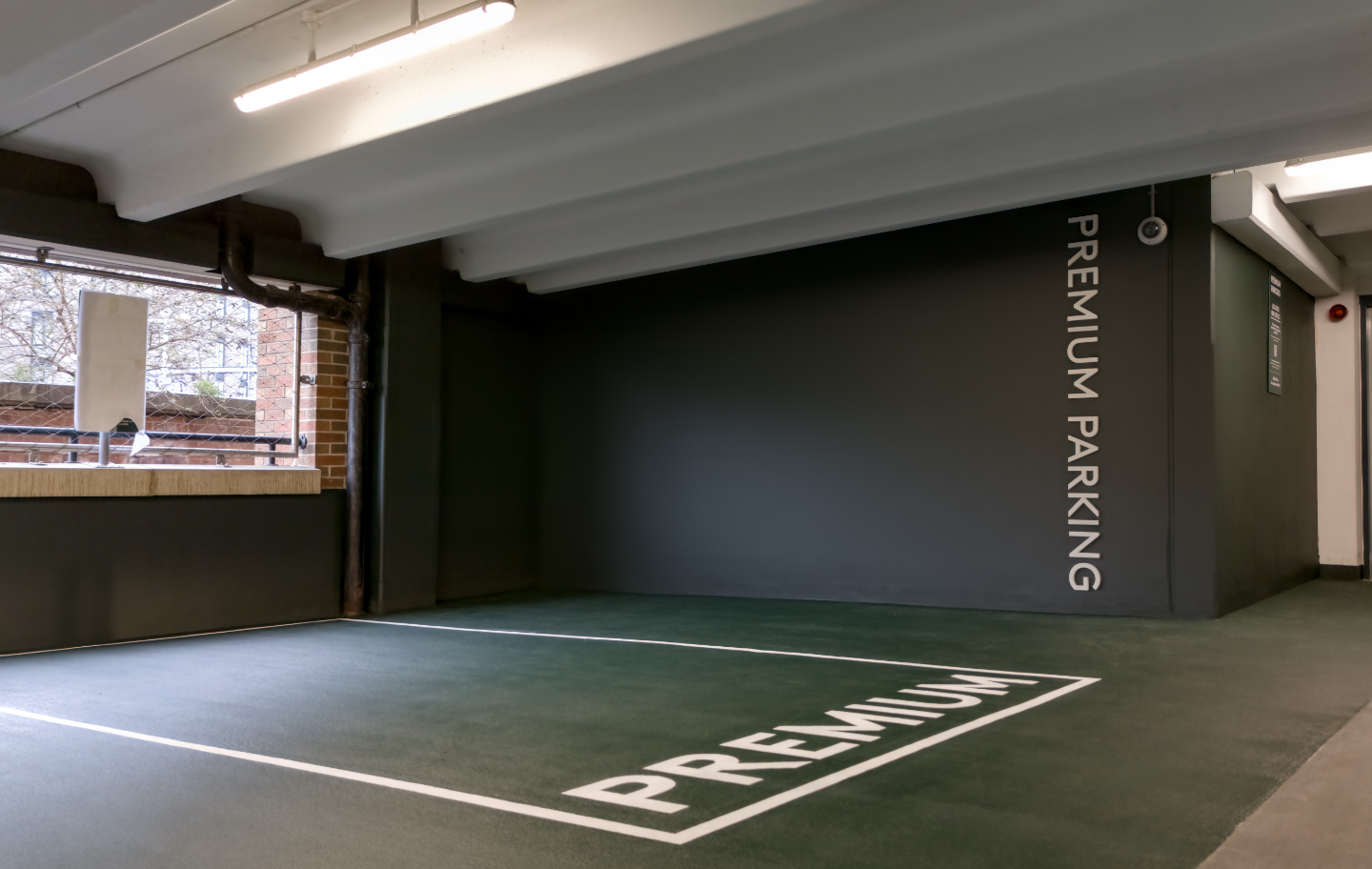
With the primed and keyed surface in place, the seal coat was applied using Sikafloor Pronto 18, tinted RAL 6009 Fir Green. The system was selected for its durability and its ability to cure rapidly in low temperatures, allowing progress to be maintained without compromising quality.
The material was applied evenly to form a seamless, continuous layer across the deck. Once cured, it created a tough, traffic-resistant surface designed to protect the concrete beneath from weather, moisture and wear.
This stage locked the system together. The result wasn’t just a finished surface, but a protective layer built to perform consistently under daily use and changing conditions.
Demarcation Installation
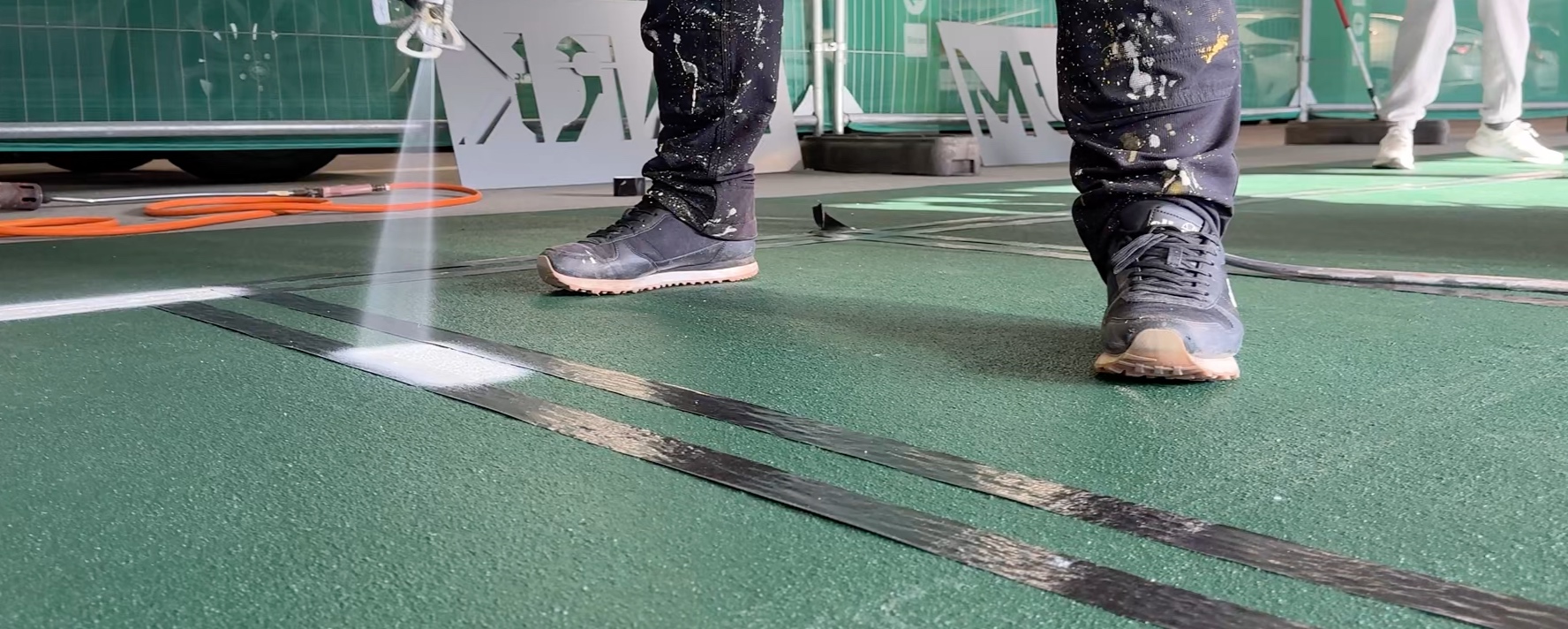
Before any markings were applied, the layout was locked in. Premium bay positions were measured, set out and taped with precision, using templates to confirm spacing, alignment and consistency across the deck.
Once approved, all markings were spray-applied using a twin-pack epoxy line marking system. This method delivered sharp edges, uniform line thickness and a finish designed to resist abrasion from tyres, weather and regular cleaning.
The result was clear, durable demarcation that defined the space properly and stayed legible under daily use — not just immediately after application.
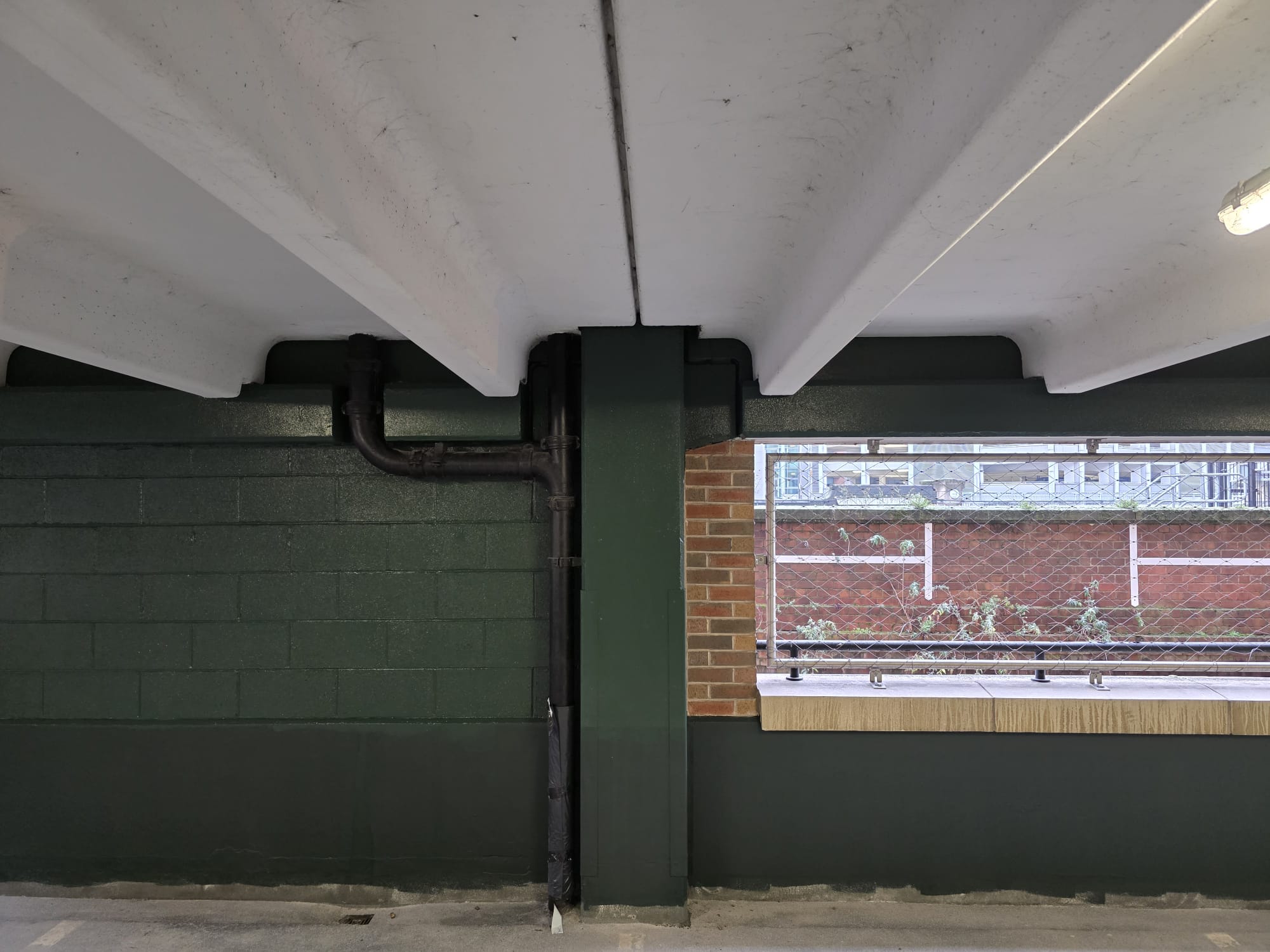
Walls and upstands were thoroughly cleaned and prepared to remove dust, surface contaminants and any loose or degraded material. Preparation was treated as part of the system, ensuring the new finish bonded properly and performed over time rather than failing early.
Once prepared, two coats of masonry paint in RAL 6009 were applied. The colour was selected to complement the deck finish and create a consistent visual language across the space. Beyond appearance, the coating provided a durable, protective finish suited to a high-use environment.
The result was a cleaner, more coherent space that supported the upgraded deck and improved the overall experience without introducing unnecessary maintenance.
Before & After
Related Services & Suppliers


Testimonials
"It was a pleasure working on the scheme with H3 Construct. This was a well managed project with a great end product and effect. The H3 Construct team were responsive, professional and genuinely believed in delivering the best possible outcome. A number of hurdles were encountered and there was always a “can do” attitude to ensure the project was successfully delivered."
Paul Leng
Portfolio Project Manager, Landsec U+I

Call us on 01204 358176
admin@h3construct.co.uk
H3 Construct Ltd
Registered Company #12263157
375 Tonge Moor Road, Bolton, BL2 2JR
Copyright 2026 H3 Construct Ltd
All Rights Reserved